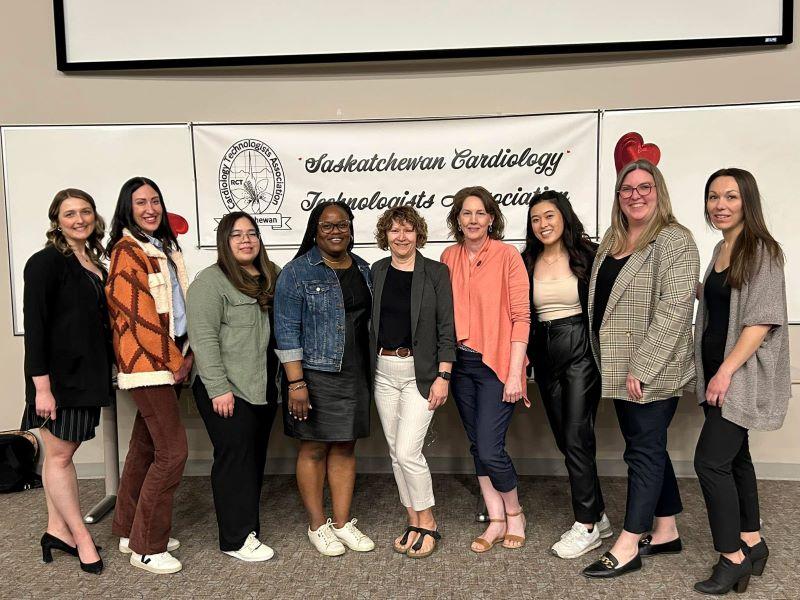
Zhealynn Topacio Career Spotlight

Zhealynn is a Cardiology Technologist/Cardiac Rhythm Device Technologist currently working in the Cardiac Device Clinic of Non-Invasive Cardiology at the Royal University Hospital (RUH) in Saskatoon. As a Cardiology Technologist she previously worked tri-site rotating through St. Paul’s Hospital (SPH) and Saskatoon City Hospital (SCH).
What are you responsible for as a Cardiology Technologist?
As a Cardiology Technologist you work with the Cardiologist to assess the function of the heart. We perform ECGs, Stress Tests also known as Exercise Tolerance Tests (ETTs) or Treadmill Tests, Tilt Table Tests, Holter Monitors and Ambulatory Blood Pressure Monitors.
Depending on the site you are working at, your typical day can look a little different.
Royal University Hospital (RUH)
At RUH we perform ECGs all throughout the hospital. We have 4 pagers that cover different areas of the hospital, these include the Ward Pager, the Emergency Department Pager, the Outpatient Pager and the JPCH Pager. Depending on the schedule you will hold one of these pagers for either the morning or the afternoon and with the other half of your day you will either be doing ETTs or Holter.
- Ward Pager – you will mostly be doing ECGs on inpatients in the ward that were requested by a physician.
- ED Pager – you will be covering all the patients in the Emergency Department. This pager can be one of the busiest pagers, as there are many patients that come through the emergency department on a regular basis. You will be performing ECGs from a variety of patients, from those in the waiting room to patients coming through trauma.
- JPCH Pager – you will be covering the Pediatric Cardiology Outpatient Clinics as well as the rest of the inpatients in JPCH which may include patients in Maternity whether it be the baby or the mother and NICU.
- Outpatient Pager – you are covering patients that are being seen as an outpatient, this includes walk-ins at Test Centre where a family doctor is requesting an ECG, to a cardiology clinic where Cardiologists may be seeing their patients as an outpatient, day surgery patients and Cardiac Short Stay patients (CSSU).
In a day we perform about 16-20 ETTs with 8-10 in the morning and again in the afternoon, depending on the number of patients confirmed and booked. While performing ETTs you are assessing a patient while they are walking on a treadmill and monitoring any symptoms and/or ECG changes that may indicate there may be a blockage in the heart or they may have an abnormal arrhythmia. This test is performed under the supervision of a Cardiologist. Prior to putting the patient on the treadmill, we prep the patient by putting on electrode stickers on their chest to monitor their ECG and a cuff to monitor their blood pressure during exercise.
We also perform Tilt Table Tests to help assess patients with presyncope, syncope, irregular arrhythmias and POTS symptoms. The hook-up is the same as ETTs, however instead of the patient walking on a treadmill, they are laying on a bed that we “tilt” to almost a standing position to assess for any orthostatic changes they may be experiencing while monitoring their blood pressure and ECG.
As the Holter person, your role includes scanning holters from various sites in the province, hooking up inpatient holters and prepping ETT patients.
Occasionally when a Stress Echocardiography (Stress Echo) or a Dobutamine Stress Test is booked, the Holter person will run this test alongside a Diagnostic Cardiac Sonographer also known as an Echo Tech and a Cardiologist. A Stress Echo test is similar to a regular Stress Test; however, the patient will be on an Ergonometric Bike while hooked up to ECG and have an echocardiogram done at the same time. If a patient has trouble with movement, a Dobutamine Stress Test is done in which medication is used to increase their heart rate.
St. Paul’s Hospital (SPH)
At SPH the tasks are similar to RUH, however instead of 4 pagers covering the entire hospital there is one pager that will cover inpatients, outpatients and the emergency department.
- ECG pager will attend to pages requested by nurses and physicians.
- Just like at RUH there will be 16-20 ETTs performed during the day.
- The Holter person has the same duties as RUH, however they are also putting on 24-hour Ambulatory Blood Pressure Monitors and printing a report to send to the patient’s family physician and requesting physician.
Saskatoon City Hospital (SCH)
At SCH there are no ETTs done at this site and most of the patients seen here are outpatients. The two tasks performed while at SCH include holding the ECG pager or hooking up outpatient holter monitors for one half of the day and then you switch to the other task for the afternoon.
There is one ECG pager that covers the entire hospital including Day Surgery Clinic, Inpatients and the Emergency Department.
The holter person oversees hooking up holter monitors as well as uploading returned holter monitors to the computer.
Both technologists working here will work together to help clean and sanitize returned monitors.
During the off shifts (Evenings, Nights and Weekends) there are either one or two Cardiology Technologists working and their main duties include attending any page requesting an ECG as well as scanning and putting on holter monitors. These occur at all 3 sites. There are no outpatients seen during these shifts, therefore most of the patients seen are from the ward or emergency department. At RUH there will be 2 out of the 4 pagers running (Ward and Emergency Department) and 1 pager each at SPH and SCH.
How is your work-life balance as a Cardiology Technologist?
As a Cardiology Technologist you are mostly working 8-hour shift work (mornings, evenings, nights and weekends). Each site runs 24/7 for ECGs therefore you will always have someone working. Holter hookups and ETTs are only performed during the day for outpatients.
The weekday morning shifts have three starting times, either 7:00am, 7:30am or 8:00am. The evening shifts begin at 3:30pm and the night shifts begin at 11:30pm.
Depending on whether you work a full-time position or part-time position there are pros and cons to shift work. If you work a full-time position, you may be working more frequently and have less days off in comparison to a part-time position. However, due to a variety of shift work, it can be beneficial for some people as you may have days off during the week where you are able to run errands or attend appointments that can only be booked from Monday - Friday (9am-5pm). It also gives us the opportunity to pick up overtime shifts.
In the past, I’ve worked as a server and in retail, and I can say that it is similar. Retail compares to the day shifts and working as a server is like working an evening shift. The night shifts can be a little tough, but if you are a night person this shift may work for you.
Have you always wanted to be a Cardiology Technologist?
In all honesty, I never knew about this profession until I heard about it from a friend who started working as a Cardiology Technologist.
I knew I always wanted to work in the healthcare field and even thought of becoming an Optometrist, however at 18 I was not yet ready to move to Waterloo, ON so I decided to do an undergraduate degree at the University of Saskatchewan. I graduated with a Bachelor of Science in Physiology and Pharmacology and even thought of pursuing Medicine or Nursing. Although, with my degree the pathways were a bit limited on job opportunities if I didn’t go into a Graduate Program. Then I discovered the Cardiology Technology program from a friend, and I decided to look into it. Both of my parents have heart conditions; my dad had CABG back in 2011 and then my mom had a pacemaker put in back in 2015. I thought that this career could help me take care of my parents and have a better understanding of it. I think that having this connection made me more interested in the program and motivated me to do well.
I learned that there was a program offered at Stenberg College in BC that allowed me to do the schooling online. Unfortunately, there are no lab instructors in Saskatchewan, so I had to go to Calgary, AB for a few weeks to do the labs. However, I was able to do a Clinical Placement here in Saskatoon.
Are there opportunities to further your career as a Cardiology Technologist?
As a Cardiology Technologist in Saskatoon, you can also work in the Sleep Lab. If you’d like to further your career you can branch out into other cardiac-related careers such as a Cardiac Rhythm Device Technologist, a Cardiovascular Technologist in the Cath Lab or an Electrophysiology Technologist in the EP Lab. These are advanced certificates that can be taken at British Columbia Institute of Technology (BCIT).
Personally, I worked as a Cardiology Technologist for about 3 years and was looking to further my career and enrolled in the Cardiac Rhythm Device Technology Program at BCIT. This program took me about 1 year to complete including a 4–6-month Clinical Placement. I found that by having the knowledge of a Cardiology Technologist, it allowed me to have a good foundation entering my current career as a Cardiac Rhythm Device Technologist.
On another note, as a Cardiology Technologist you are given the opportunity to attend CSCT events (Canadian Society of Cardiology Technologists) such as the CCC (Canadian Cardiovascular Congress) and now the Symposium which are held in a different Canadian city each year. These events allow Cardiology Technologists to have more educational opportunities to learn about new studies to improve patient care as well as network with other cardiology colleagues.
Do you have any advice for students or new graduates looking to pursue a career as a Cardiology Technologist?
My advice for students and new graduates that are looking to pursue a career as a Cardiology Technologist is to be open-minded and take everything in. Not everything will be black and white. You will quickly learn that there are a lot of grey areas that you will want direct answers to, however that is not always the case. It allows you to develop your critical thinking skills. There will always be something new to learn.
There are a variety of duties to do as a Cardiology Technologist that you will always have the opportunity to do something different every day.
Also, don’t beat yourself up if you are having trouble understanding how to read an ECG or use the equipment, as everything will come with time and experience. Before you know it, you’ll be able to do it all with your eyes closed!
A career as a Cardiology Technologist is a great opportunity for those who may not want to pursue Nursing but still want to work in the healthcare field, while making comparable earnings.
What is the number one thing you love about being a Cardiology Technologist?
I’d say the number one thing I love about being a Cardiology Technologist is being able to help improve someone’s health or life. As a Cardiology Technologist, you might be the first person to discover someone having a heart attack or having some type of heart block where they may be needing a pacemaker. Just by having these skills, you can make a difference in someone’s life!