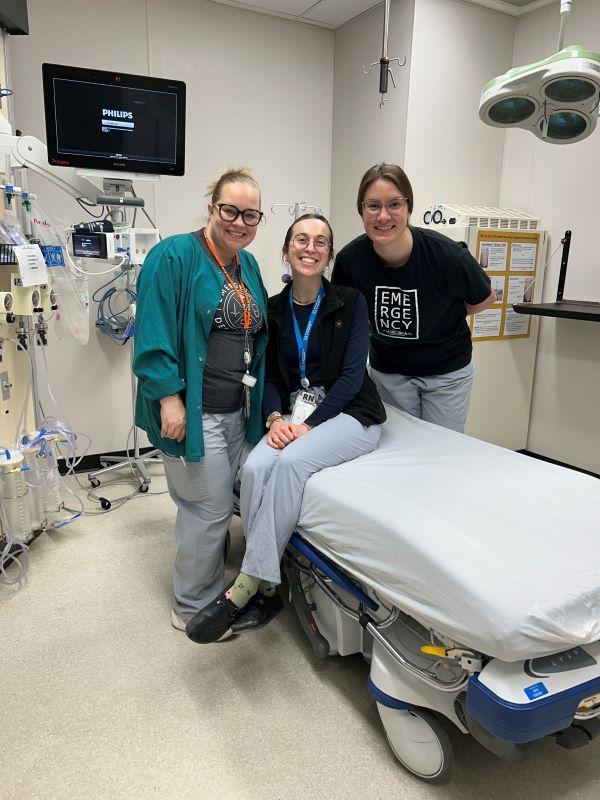
Maria Matovich Career Spotlight
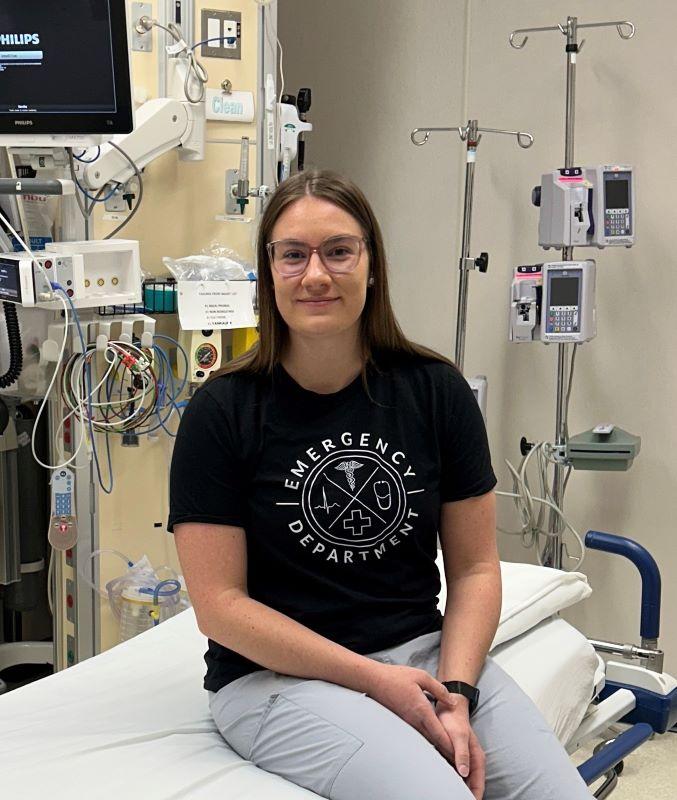
My name is Maria Matovich, I am an Emergency Room Registered Nurse. I work in the Emergency room of the St. Paul’s Hospital in Saskatoon, Saskatchewan.
What are your responsibilities as a Registered Nurse in an Emergency Room?
My typical day in the Emergency Room varies significantly. I may work in triage, trauma, or the pink and yellow zones, where patient acuity ranges widely, from minor emergencies to death. In triage, I am often the first point of contact, gathering the patient’s chief complaint, assigning a CTAS score, and helping place patients throughout the department based on urgency and presentation.
Working in trauma involves caring for the most critically ill patients, including managing codes, assisting with procedural sedations, and responding to high‑acuity emergencies. In the pink and yellow zones, my role includes initiating patient care through directives, completing assessments and vital signs, administering medications, and closely monitoring patient status.
Across all areas of the department, continuous assessment is essential to identify changes in condition and intervene promptly, whether through minor interventions or life‑saving treatments. With many new graduates and nursing students completing practicums in the department, mentoring and assisting with orientation is also a regular part of my work. Collaboration among staff, along with support from nurse educators, plays an important role in guiding and supporting new team members and future nurses.
How would you describe your work–life balance as a Registered Nurse working in an Emergency Room?
Working 12‑hour shifts is very different from a typical Monday‑to‑Friday schedule. I work twelve 12‑hour shifts over a four‑week rotation, and while it may appear to offer more days off, the body requires time to recover after a set of shifts. Despite this, I truly enjoy the 12‑hour schedule, as it allows me to intentionally prioritize rest, exercise, and nutrition on my days off. Activities such as spin classes and regular movement, spending quality time with my fiancé and our dog, and being outdoors are essential parts of my life that I make a point to prioritize during my time away from work.
Have you always wanted to be a Registered Nurse?
My initial plan after high school was to pursue a career as an exercise or physical therapist. However, midway through my final year in the kinesiology program, I began exploring the Registered Nursing program and became increasingly interested in nursing. Completing a kinesiology practicum helped me realize that I wanted a faster‑paced environment with variety and new challenges each shift, something that aligned well with the role of a Registered Nurse. Additionally, having family members navigate the healthcare system reinforced my desire to help others and to support individuals during some of the most stressful and uncertain moments of their health journeys. While in school, I worked as a lifeguard, where I regularly responded to first aid situations and emergencies. These experiences confirmed that healthcare, and particularly a hands‑on, dynamic role, was where my true calling lay.
What career advancement opportunities exist for Registered Nurses?
In critical care, there are opportunities to advance into specialized areas such as the Intensive Care Unit or Coronary Care Unit. With additional experience, pathways may also include STARS and air ambulance services. Beyond bedside practice, there are continued opportunities to move into roles such as educator, clinician, or clinical coordinator.
Do you have any advice for students or new graduates pursuing a career as a Registered Nurse in an Emergency Room?
My advice for students or new graduates considering nursing, particularly in the Emergency Room, is to be prepared for a fast‑paced and often chaotic environment. The Emergency Room is constantly changing, so adaptability and readiness for the unexpected are essential. It is equally important to prioritize your physical and mental well‑being. Taking care of yourself allows you to be in the right mindset to care for others effectively, especially in critical care and emergency settings. The intensity and acuity of situations can take a personal toll, so it’s important to make use of available supports and resources to maintain your well‑being.
What is the number one thing you love about working as a Registered Nurse in an Emergency Room?
Every shift brings something different, providing constant opportunities to learn and grow. My skills continue to develop as my knowledge base expands. I collaborate closely with a wide range of health professionals both within the hospital and in the community. I regularly care for high‑intensity, critically ill patients at the point of their initial presentation. Exposure to diverse and complex patient conditions keeps me adaptable and allows me to draw on my training and experience to deliver the highest possible standard of care.