

Sarah Nakonechny-Wheler Career Profile
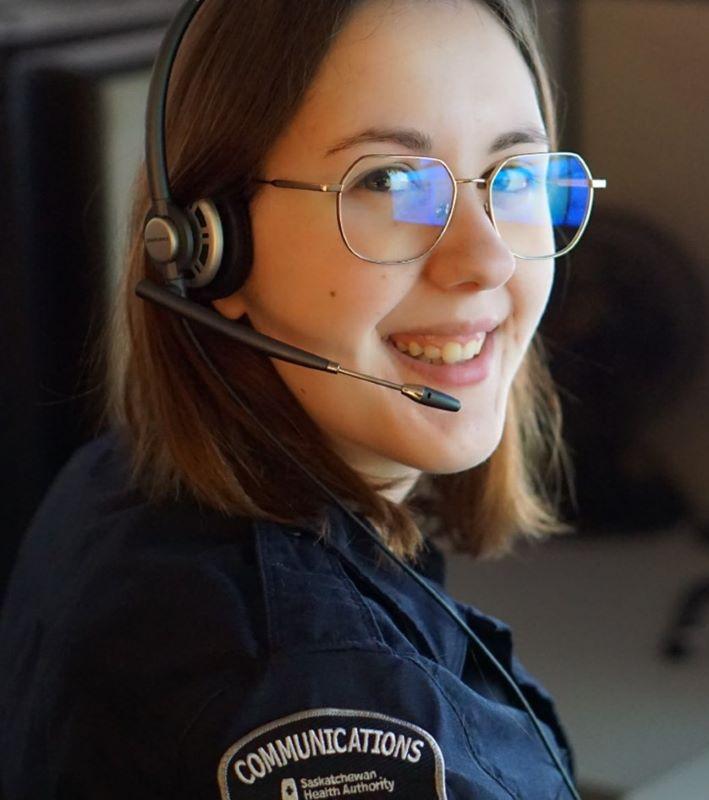
Sarah is a Communications Specialist functioning as a Call Evaluator in Regina at the Medical Communication and Coordination Centre South.
What are you responsible for as an Emergency Medical Dispatcher – Call Evaluator?
As an Emergency Communication Specialist functioning as a Call Evaluator, we are responsible for answering all emergency medical calls that the centre receives, gathering specific information from callers to ensure they receive the most appropriate care, providing callers with instructions prior to ambulance arrival, scheduling interfacility transfers, and communicating with other agencies regarding different call details.
To say that there is a ‘typical’ workday would be inaccurate. Although the general task of answering the phone doesn’t change day to day, what you can expect to receive on the other end of the line is unpredictable. There is no such thing as a dull, standard day as you can never be certain what you may end up encountering when you sit down each day.
What is the most rewarding part of knowing your voice is the first thing someone hears on their worst day?
It’s knowing that even though those who call would rather be in any other situation, they are relying on me to help them and it’s the privilege I have to be able to help them.
Can you describe a specific call for service where you felt you truly made a difference?
It was a rural call from one of the curling rinks for an elderly man. Initially the caller reported that the patient was having chest pain. During the call the patient became unconscious. While pivoting with the new information I had instructed them to send someone to get an automated external defibrillator (AED) if one was available in case we needed it later. After someone returned with an AED the patient stopped breathing. I immediately walked them through how to attach the AED and it administered a shock and the patient began breathing again as the ambulance pulled up.
What does ‘serving your community’ look like from behind a console?
To me this looks like showing up every day regardless of what else may be going on in your life ready to serve those who need us to a high and consistent standard. It means being ready each and every time the phone rings no matter how tired you are or what time it is. Most importantly, I think it’s the reassurance that we provide our community as they know that we will always be on the other end of the line when they need us.
How would you describe the bond between communication centre staff during a high-stress shift?
It’s like watching a movie. Everyone knows the end goal of the plot, what their lines are, and the actions needed to get us there. There is confidence that is felt in the room that everyone knows what is needed of them and that they will execute their role effectively. We know each other’s lines so if we need to step in to support, we can without being asked to ensure success. The common goal of getting people an ambulance will be achieved successfully, credits will roll, and then we start it all over again.
What surprised you most about the EMS communication centre culture when you started?
What surprised me was how tightknit the bonds are between everyone. In here, you spend a lot of time together and you work through difficult situations that bond you in a way that doesn’t exist in other jobs. Now it’s almost impossible for me to think about not having this kind of connection with everyone here.
What personality traits make someone successful in this specific environment?
- Resilient
- Organized
- Dedicated
- Compassionate
- Team Player
How do you decompress after a shift, knowing you’ve helped save lives?
I take the time after to appreciate how quickly things can change so I try to connect and visit those I care about as often as possible. I also try to relax by reading, exercising, and spending a little extra time with my cats.
