

Madison Higgs Career Spotlight
Madison Higgs is a Registered Respiratory Therapist at Battleford Union Hospital (BUH). As a rural Registered Respiratory Therapist (RRT) Madison works in multiple high-acuity and general areas across the facility. Some of the areas she covers in the hospital are; intensive care unit (ICU), Emergency room (ER), Maternity, various wards (which include adult and pediatric), Operating room (OR), etc.
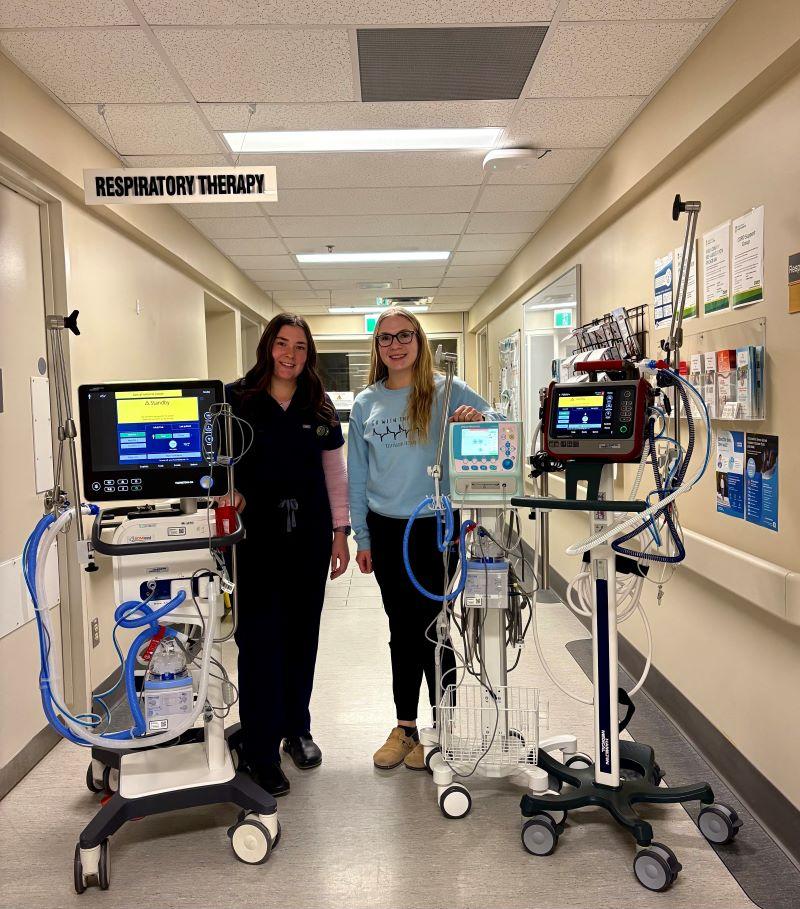
What area of healthcare do you work in? Where do you work?
I work at BUH. As a rural RRT I am able to work in multiple high-acuity and general areas across the facility. Some of the areas we cover in the hospital are; ICU, ER, Maternity, various wards (which include adult and pediatric), OR, etc.
What are you responsible for as a Respiratory Therapist? Please describe a typical day for yourself.
RTs are trained to manage and treat a broad spectrum of cardiopulmonary diseases and disorders for all patient populations. So, we are able to work with patients when they are first born all the way through to end-of-life care. Very general core responsibilities of a RT include patient assessment, therapeutic intervention, and evaluation of care.
RTs are able to care for patients of all ages and in all departments. A huge responsibility of an RT is being able to triage tasks based on acuity especially in a rural hospital due to there usually only being one RT on at a time. As RT’s we can follow patients as they transition from the emergency department to the wards, ICU to a bigger facility and upon discharge home.
Some of our main responsibilities throughout the hospital are initiating, managing, and weaning invasive and non-invasive ventilation as well as titrating oxygen. RTs manage various artificial airways such as endotracheal tubes, tracheostomy tubes, and laryngectomy tubes. RTs are an essential member of the Code Blue, and rapid response teams handling all emergency airway and respiratory needs such as bagging, intubating, and ventilating the patient. RTs are able to insert arterial lines, perform arterial blood gases, then we are able to analyze and change patient respiratory support based on the results. Additionally, RTs are present for procedural sedations for airway and respiratory support if necessary. We also participate daily in interdisciplinary rounds. At BUH we are able to attend all high-risk deliveries and c-sections to perform resuscitation on newborns including premature infants with underdeveloped lungs. Specifically at children hospitals RTs are a vital part of the NICU transport team that travels by road and air to safely transport critically ill infants from smaller centers such as BUH.
How is your work-life balance as a Respiratory Therapist?
As an RRT there is a wide variety of schedules available to you, which allows for a lot of flexibility and control over your work-life balance. There are career options available with a traditional Monday-Friday 8-5 schedule, particularly in areas like pulmonary function labs and home oxygen companies. There is also the typical health care schedule featuring 12-hour day or night shifts which is more prevalent in the acute care part of respiratory therapy. There is also the option to work as a casual, part time or full time RRT, so there are lots of different schedules open to fit your lifestyle. As a full-time RRT at BUH, my typical shift runs from 07:30 to 19:47, and then I am on call until 07:30 the next morning. So, depending on patient needs throughout the hospital I might be required to return to BUH multiple times throughout the night. Compared to other jobs I have had; I find I have a better work-life balance due to having more days off during the month and being able to take days off easily if needed thanks to my great co-workers at BUH.
Have you always wanted to be a Respiratory Therapist?
No, I had not always wanted to be a respiratory therapist. Like most people in grade 12 I had no idea what I wanted to have for a job, I knew I really wanted to do a career in health care but there were so many options I was unsure which path was best for me. I ended up applying to lots of different options, and thought I would pick from there. I had no idea what an RT was when The Southern Alberta Institute of Technology (SAIT) sent out an email highlighting what an RT is and offering to waive the application fee, I thought there was no harm in applying. I then ended up getting accepted and moved away to Calgary to learn a lot at SAIT about how to be an RT. I was fortunate enough to come back to Saskatchewan and complete my one year of practicum in Saskatoon with the great RTs at Royal University Hospital, St. Paul Hospital and Jim Pattison Children’s hospital. Once I graduated, I started my career at Battleford Union Hospital. The decision to apply to a program I knew nothing about turned out to be the best career move I could have made.
Are there opportunities to further your career as a Respiratory Therapist?
Absolutely there are a lot of opportunities to further your career as an RT. There are many different options to work inside and outside the hospital. There are options to specialize in areas such as Neonatal/Pediatric ICU (NICU/PICU), acute care, air transport, bronchoscopy suits, anesthesia assistant, perfusionist, long-term care, asthma/COPD education, home oxygen, pulmonary function testing (PFT) labs and many more. There are also opportunities for leadership such as moving into roles as a clinical educator, or manager. For example, one of our RTs at BUH stepped into a management position about a year ago, she manages the intensive care unit, emergency department, ambulatory care center ortho tech and respiratory therapy department.
Do you have any advice for students or new graduates looking to pursue a career as a Respiratory Therapist? Are there specialty areas that are in more demand than others?
Advice I have for new grads as a recent grad myself is to not be afraid to have conversations with the interdisciplinary team. Everyone has the same goal of helping the patient, so your knowledge is very important to share. Some other things to know is in Canada RT’s have different scopes as RT’s but no areas in particular are in more demand than others, there are plenty of positions available in most locations. And don’t be afraid to take a position in a place where you’re not super comfortable. The only way to get comfortable is by experience.
What is the number one thing you love about being a Respiratory Therapist?
The number one thing I love about being a respiratory therapist is the unpredictable and dynamic nature of the job; I never have the same day twice. Every day comes with new challenges and learning opportunities. Because my role at BUH requires me to cover multiple different floors by myself; I constantly get to deal with different patient populations and situations. I love how I learn something new every day ensuring I am always growing my skills as an RRT. I love my career as an RRT. It truly is such a rewarding job.
