

Kas Tran Career Spotlight
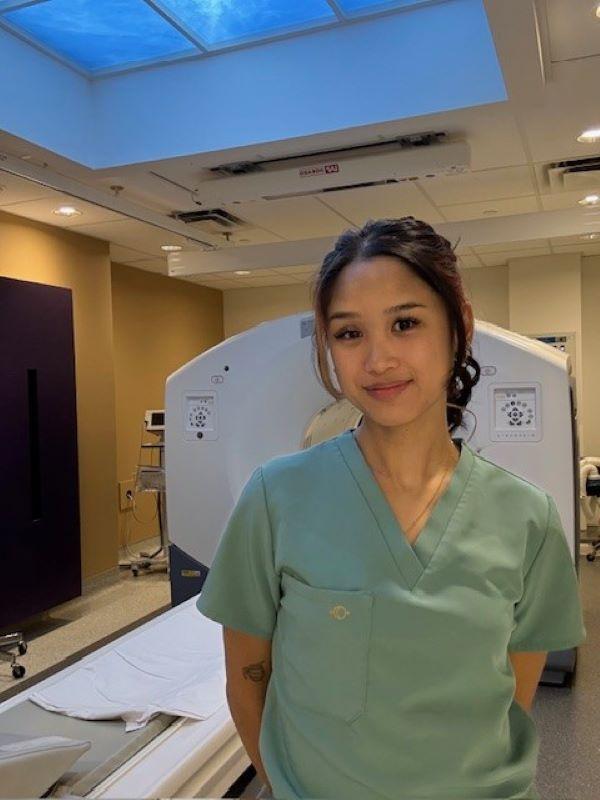
Kas is a Nuclear Medicine Technologist with the Saskatchewan Health Authority. Read more about her career journey below!
What area of health care do you work in? Where do you work?
I work in Positron Emission Tomography and Computed Tomography (PET/CT) which is a specialty of nuclear medicine and a part of the diagnostic imaging family. I mainly work at Royal University Hospital in Saskatoon but will occasionally rotate to St. Paul’s Hospital or Saskatoon City Hospital if I’m working in general nuclear medicine that day.
What are you responsible for as a Nuclear Medicine Technologist Specialty PET/CT?
The day starts by opening up the department. This consists of running quality control in the radiopharmacy and on the camera. I then prepare outgoing shipments to the cyclotron and wait for the morning shipment of Fluorodeoxyglucose (FDG). By then, patients start arriving, so we are also getting their exams started. The main part of the job is screening and setting up patients and then scanning them. We also make Prostate-Specific Membrane Antigen (PSMA), which is a radiopharmaceutical for our prostate cancer patients. Our shifts start at variable times, ranging from 7 am to 11 am, so depending on the shift, you’ll have different responsibilities.
How is your work-life balance as a Nuclear Medicine Technologist Specialty PET/CT?
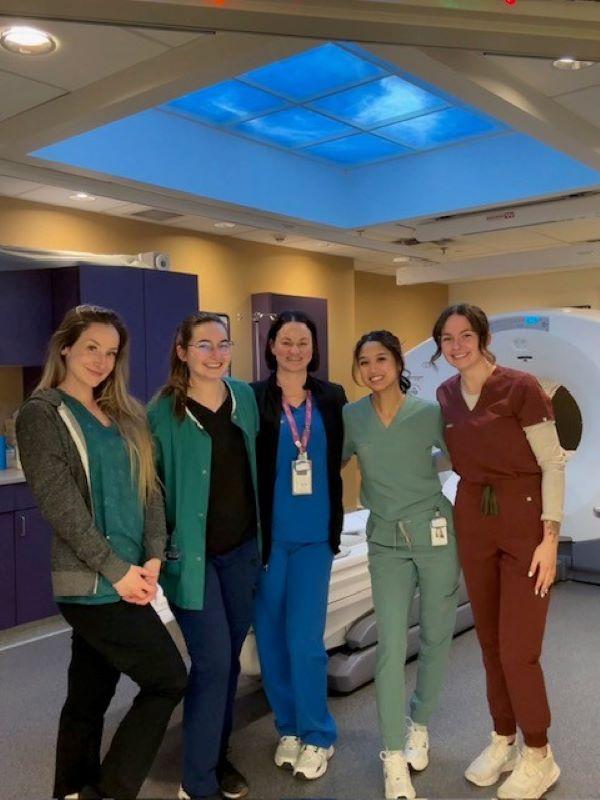
My work-life balance as a PET/CT technologist is good. For the most part, the work itself isn’t too draining and gives me time to pursue other things in my life like sports, hobbies, and other business ventures. I like it because I don’t take my work home with me. The end of the work day means end of the day. Our department does not run 24 hours since we are restricted by the radioactive decay, so there’s no shift work which is nice, and due to the nature of our exams there’s no being on-call for PET/CT. Compared to other jobs I’ve had, it is not too shabby! The benefits are good and I love the team I get to work with.
Have you always wanted to be a Nuclear Medicine Technologist Specialty PET/CT? Tell us more about your career path!
No, for the longest time I wanted to be a vet, but that dream stopped at an early age. After high school I went to the University of Saskatchewan for Business School for a year and decided it wasn’t for me. I was looking at the Southern Alberta Institute of Technology (SAIT) website for ultrasound programs and saw the nuclear medicine technology program in the recommended area, so I applied and got in and have been into it ever since!
Are there opportunities to further your career as a Nuclear Medicine Technologist Specialty PET/CT?
The first step to becoming a Nuclear Medicine Technologist Specialty – PET/CT is to become a Nuclear Medicine Technologist. Once you have completed this training you can do additional training to become a PET/CT technologist.
Presently, there is only one PET/CT camera in Saskatchewan which is located at the Royal University Hospital (RUH) in Saskatoon. If you are looking to grow your career, there is the opportunity to advance into a Nuclear Medicine Technologist PET/CT Supervisor.
We also have the option to work in CT by completing additional coursework to obtain a certificate. If someone is interested in returning to school, there is also an MRI second-discipline program available.
By having the base education of nuclear medicine technologist, it opens more opportunity to explore other imaging modalities.
PET is a growing modality and PET/MR is slowly being integrated in Canada. I’m excited to see where technology takes us!
Do you have any advice for students or new graduates looking to pursue a career as a Nuclear Medicine Technologist Specialty PET/CT? Are there specialty areas that are in more demand than others?
Go for it! Right now, there is a high demand for nuclear medicine technologists. I’m not going to lie, the schooling is challenging and comes with a heavy course load but goes by quickly and it’ll be done before you know it! Once you have completed your schooling you can move right into your career and you don’t have to worry about not finding a job after graduation!
What is the number one thing you love about being a Nuclear Medicine Technologist Specialty PET/CT?
Beyond working with a great crew and meeting lots of people from different backgrounds every day, I love telling people I’m a nuclear medicine technologist and seeing their surprise or curiosity about what the role involves. Many people are unfamiliar with the profession or have never heard of nuclear medicine. Admittedly proud, I thoroughly enjoy working with patients and having the opportunity to work at the only PET/CT camera in the Saskatchewan.
