

Creating Conditions for Culturally Safe Health Services
Improving health experiences and outcomes of First Nations and Métis Peoples requires culturally responsive care that respects Indigenous worldviews, knowledge, and practices.
- Making all care environments physically, emotionally, spiritually, and culturally safe.
- Recognizing and addressing the impacts of racism and trauma.
- Removing barriers that make it difficult for Indigenous Peoples to access care.
- Improving access to traditional wellness and healing practices, including traditional medicines.
What is cultural safety and why does it matter?
Cultural safety is a concept used across Canadian health-care systems that focuses on creating environments where patients feel safe, respected, and free from racism and discrimination. The First Nations Health Authority (FNHA) defines cultural safety as an outcome determined by the patient—where their identity, needs, and experiences are honoured without challenge or denial.
In Canada, organizations such as the First Nations Health Authority (FNHA), Indigenous Physicians Association of Canada (IPAC), HealthCareCAN, and the Truth and Reconciliation Commission (TRC) emphasize that cultural safety goes beyond awareness or sensitivity. It requires health-care providers and organizations to:
- Recognize and address power imbalances in care
- Understand the impacts of colonialism, intergenerational trauma, and systemic racism
- Reflect on their own assumptions and biases
- Adapt care to meet the cultural, spiritual, and social needs of patients
From Knowledge to Practice
Turning Our Commitment into Action
The following tools and resources are designed to help you turn this understanding into everyday practice. They provide practical guidance, supports, and pathways to deliver culturally safe care in your role.
Resource | Author | Description | Time |
|---|---|---|---|
| Indigenous Health System Transformation | Indigenous Primary Health Care Council Ontario | Tool that details foundational components and concepts for Indigenous Health Systems Transformation. Not unique to PHC. | 30-40 min read |
| Safe and Respectful FNIM Maternal and Newborn Care | Healthcare Excellence Canada | Virtual discussion builds awareness and understanding of the experiences of First Nations, Inuit and Métis, and to discuss ways to provide safer maternal and newborn care. | 60 min webinar |
| Interior Voices Podcasts | Interior Health, BC | Podcast series that explores the intersection of health and culture in the workplace, our everyday lives and patient care. | At your own pace |
| Indigenous Birth Support Workers | Saskatchewan Health Authority | Learn how culture is infused throughout the birth experience in SHA. | 2 min video |
| First Nations, Inuit and Metis Experiences with Racism in Healthcare Systems | Healthcare Excellence Canada | Learn about safety incidents in the form of dehumanization and the harms resulting from racism. First Nations, Inuit and Métis leaders from across the country discuss how their healthcare organizations are addressing systemic racism and improving cultural safety. | 1 hr 25min webinar |
| Call for Equitable Indigenous Healthcare in Canada: Nation to Nation Collaboration | Dr. Gary Groot, Rose Richardson | Learn more about respecting Traditional Wellness and Healing practices alongside Western Medicine in Saskatchewan. | 15 min video |
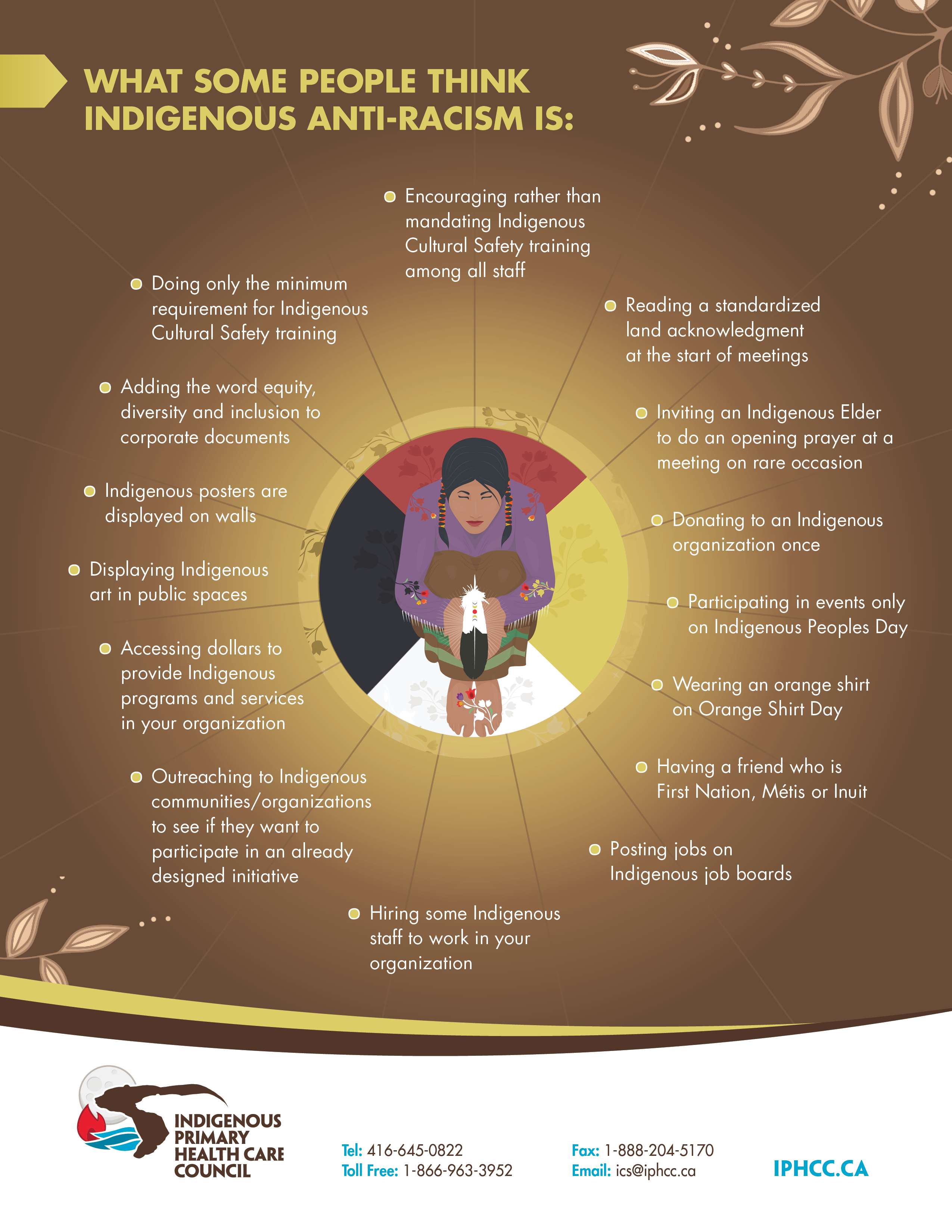
| What some people think Indigenous Anti-Racism Is | Indigenous Primary Health Care Council Ontario | To be used with "What Indigenous Racism Actually is". Consider reviewing these documents with your colleagues/teams in a safe, respectful conversation about racism | 2 min read |
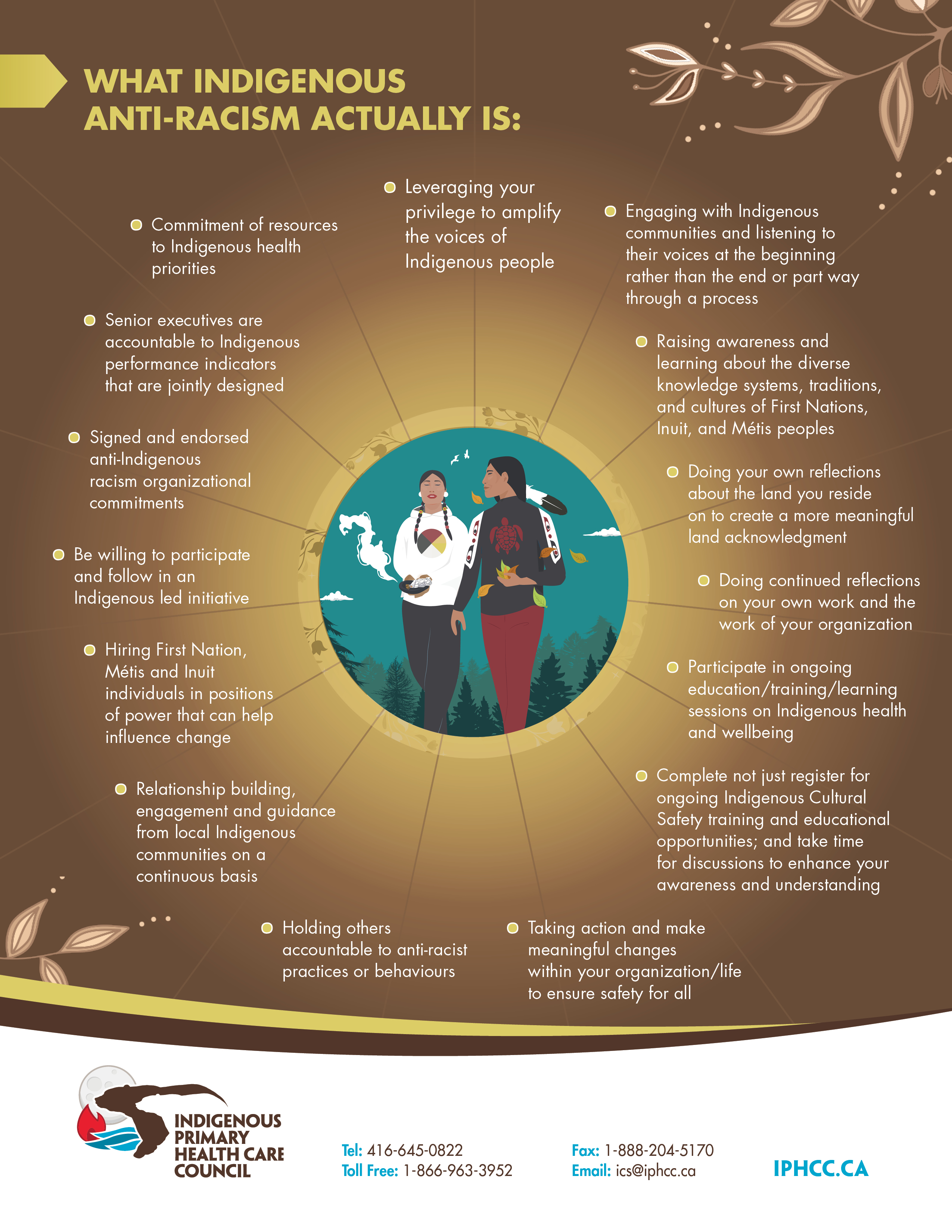
| What Indigenous Anti-Racism Actually Is | Indigenous Primary Health Care Council Ontario | To be used with "What Indigenous Racism Actually is". Consider reviewing these documents with your colleagues/teams in a safe, respectful conversation about racism | 2 min read |
| Indigenous Nurses Professional Practice Group | kā-wīci-pimohtēmāt Professional Practice Group | Platform for communication between the College of Registered Nurses of Saskatchewan and Indigenous nurses in Saskatchewan. Access to a range of courses, resources, tools, relevant to a range of health care providers. | At your own pace |
| Cultural Safety: Respect and dignity in relationships | National Collaborating Centre for Indigenous Health, Northern Health Authority | Learn about the impact of colonialism on Indigenous health and what Northern Health is doing to address health inequities through cultural awareness, sensitivity, competency and humility | 5 min video |
| Our Hair, Our Spirit | Saskatchewan Health Authority | Learn why hair is sacred to Indigenous peoples. (See also SHA Indigenous Haircutting Policy in Implementation link below). | 9 min video |
| Disrupting for Culturally Safe Health Systems | National Collaborating Centre for Determinants of Health | Season 4, Episode 3 part of a larger series on disrupting systems for improvements, this episode delves into what we can do to promote culturally safe places and spaces across the health system, featuring Dr. Terri Aldred, Physician and Academic Lead for National Collaborating Centre for Indigenous Health. | 49 min podcast |
| SHA Shared Journeys of Truth and Reconciliation | Saskatchewan Health Authority | Browse the SharePoint, learn from colleagues and watch their Shared Stories. | At your own pace |
Resource | Author | Description | Time |
|---|---|---|---|
| SHA Indigenous Cultural Responsiveness Policy | Saskatchewan Health Authority | Familiarize yourself and your teams with SHA policies, guidelines and strategies. | 10 min read |
| SHA Culture of Safety Policy | Saskatchewan Health Authority | Familiarize yourself and your teams with SHA policies, guidelines and strategies. | 10 min read |
| A Journey We Walk Together: Strengthening Indigenous Cultural Competency in Health Organizations | Healthcare Excellence Canada | Provides tools and examples to advance cultural competency. Appendix A contains a self-assessment tool to help monitor personal change; Appendix B assesses organizational progress | 30-40 min read |
| CPR Racism | College of Registered Nurses of Saskatchewan in collaboration with Dr. Holly Graham, University of Saskatchewan | A guide to address racism in health care (can be applied to any employee group) | 14 min video |
| Power Over Pain Portal | Canadian collaboration of people living with pain, clinicians, researchers, and representatives of community organizations | See Links to Indigenous language brochures and videos for care providers translated into Indigenous languages in Saskatchewan | At your own pace |
| Visits with First Nations Psychologists | Co-hosted by Dr. Brenda Restoule (First Peoples Wellness Circle), Dr. Holly Graham (University of Saskatchewan), and Dr. Alanaise Ferguson (University of British Columbia-Okanagan) | Journey into the world of psychology and mental health and wellness. | 35 min podcast |
| Smudging Guidelines at Interior Health | Hosts Natalie Daniels and Mary Jack are joined by special guest, Lenora Starr, MSW, Indigenous Cultural Safety Practice Lead with Indigenous Partnerships | Learn about the work to uplift the current IH Smudging Guidelines into a formal policy to support Indigenous clients to have culturally safe and supported spaces to incorporate their traditional Indigenous healing practices into their wellness journey with Interior Health. | 31 min podcast |
| Indigenous Health, impacts of colonization and anti-Indigenous Racism in Health Care | Dr. Marcia Anderson | Discussion on approaches to healing that can be applied to overcoming almost any form of racial trauma. | 36 min podcast |
| Saskatchewan Health Authority | The policy and procedure highlight the importance of hair in Indigenous culture and provide steps to ensure culturally safe care is provided. | 20 min read | |
| Indigenous Smudging Ceremony Policy | Saskatchewan Health Authority | The SHA supports and facilitates Indigenous smudging ceremonies in SHA facilities and programs as part of its commitment to reconciliation, cultural responsiveness and respectful care. | 20 min read |
Resource | Author | Description | Time |
|---|---|---|---|
| A Journey We Walk Together: Strengthening Indigenous Cultural Competency in Health Organizations | Healthcare Excellence Canada | Provides tools and examples to advance cultural competency. Appendix A contains a self-assessment tool to help monitor personal change; Appendix B assesses organizational progress | 30-40 min read |