

Public Access Defibrillation (PAD)

Every minute counts during a cardiac arrest.
A sudden cardiac arrest can happen to anyone, anywhere, at any time. Immediate CPR and early defibrillation with an Automated External Defibrillator (AED) can significantly improve a person's chance of survival.
Public Access Defibrillation (PAD) aims to make AEDs more accessible in workplaces, businesses, recreational facilities, schools, and community spaces. AEDs are designed with clear voice and visual prompts, making them easy for anyone to use during a cardiac arrest. By promoting AED readiness, encouraging CPR training, and building public awareness, communities across Saskatchewan can be better prepared to respond when an emergency occurs.
The PAD Program supports public education and awareness initiatives that help people recognize the signs of cardiac arrest and understand the important role AEDs play in saving lives.
What You Can Do
- Help make an AED available in your workplace, organization, or community space.
- Learn CPR and how to use an AED.
- Ensure AEDs are visible, accessible, and ready for use.
- Promote emergency preparedness in your workplace or community.
- Share survivor stories that highlight the impact of early defibrillation.
- Raise awareness about sudden cardiac arrest and the importance of acting quickly.
Keep Your AED Ready to Save a Life
- Check your AED monthly: Each site is responsible for maintaining their AED. Routine monthly checks take less than a minute. Record each check on a log sheet.
- Check the status indicator (readiness symbol): Confirm the AED is ready for use by checking that the indicator light is flashing or displays "OK" on most models.
- Verify expiry dates: Record the battery expiry date when installed. Avoid removing the battery or turning on the AED unless necessary to help the battery last as long as possible.
- Confirm accessibility: Ensure the unit remains clear of obstructions and accessible at all times.
Did You Know?
- Cardiac arrest happens when the heart suddenly stops beating, cutting off blood and oxygen to the brain and body.
- CPR (Cardiopulmonary Resuscitation) keeps blood and oxygen flowing until emergency help or a defibrillator arrives.
- An AED (Automated External Defibrillator) checks the heart's rhythm and, if needed, gives a life-saving shock to restart the heart.
- Providing immediate, high-quality CPR and using an AED as soon as possible gives the person in cardiac arrest the best chance of survival.
- Every minute without CPR or an AED reduces the chance of survival by 7-10%.
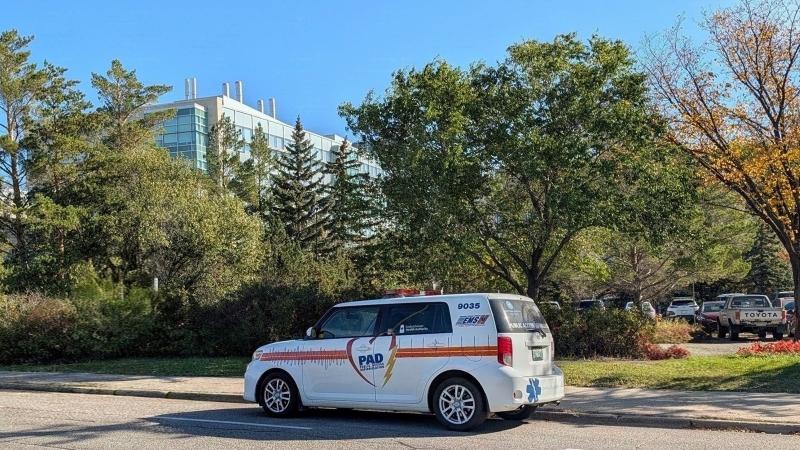
The PAD Program recently held an AED and hands-only CPR demonstration for a small group at the University of Regina.
These free sessions teach you the basics of using an automated external defibrillator (AED) and how to respond during a sudden cardiac arrest. You will see how an AED works and build the confidence to act in an emergency.
Want to host a session for your workplace or group?
Presentations are free and take about 1.5 hours. To learn more or book a session, email PAD@saskhealthauthority.ca.
Related Documents
How to Use an AED
How an AED Works

Public Access Defibrillation
Saskatchewan Health Authority
1350 Albert Street
Regina, SK S4P 3R8
- Phone: 306-766-6265
- Cell: 306-533-0027
- Email: pad@saskhealthauthority.ca
